



How Google Is Quietly Trying to Fix the AI Click Crisis
Quick Summary
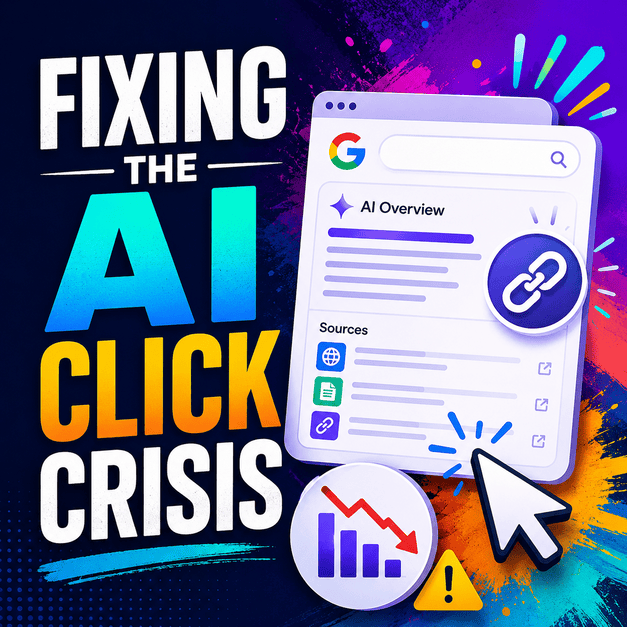
Google is responding to growing criticism about declining organic clicks from AI search by expanding citations, source links, and publisher visibility inside AI Overviews, as multiple studies suggest AI-generated search results reduce click-through rates and are reshaping SEO toward citation-based visibility.
Introduction
When Google first launched AI Overviews, the conversation focused on accuracy problems. People mocked bizarre answers, SEO professionals debated traffic loss, and publishers warned that Google was becoming an “answer engine” instead of a traditional search engine.
Now Google appears to be responding to a different problem entirely: the growing backlash over disappearing organic clicks.
Over the last few weeks, Google has rolled out multiple updates designed to make websites more visible inside AI Overviews and AI Mode, as detailed in its own product updates on Google Search Blog. That timing is not accidental. Publishers, marketers, and SEO professionals are increasingly questioning whether AI search is draining website traffic away from the open web while giving very little back.
Internal context is important here because this shift is not isolated. It builds directly on the broader “Zero Blue Links” evolution in Google Search, where traditional organic listings are increasingly being replaced or pushed below AI-generated summaries.
In a related breakdown of this shift, I explore how Google’s move toward AI Overviews and AI Mode is fundamentally changing what it means to rank, get clicked, and even be visible in search results. That evolution sets the foundation for understanding why Google’s recent updates are focused so heavily on adding more links and citations back into AI search experiences.
And for the first time, Google’s product changes suggest it is actively responding to the impact AI Overviews are having on organic clicks.
Google Is Adding More Website Links Inside AI Search
In May 2026, Google announced several updates to AI Overviews and AI Mode that increase the visibility of external websites inside AI-generated search results. These updates include:
- More inline source links
- “Further exploration” website sections
- Subscription labels for publisher content
- Expanded citation panels
- More prominent source attribution
Google says the goal is to help users “find relevant websites, deep insights, and original content from across the web” in its AI search experience.
That may sound minor on the surface, but it represents a meaningful shift in Google AI search strategy.
For months, publishers have argued that AI Overviews summarize content so effectively that users no longer need to click through to the original source. Google has repeatedly defended AI search by claiming it still drives traffic to websites, but external reporting from platforms like Digiday suggests meaningful referral declines tied to AI summaries.
Now Google is visibly redesigning AI-generated search experiences to encourage more outbound clicks.
That strongly suggests internal data may be showing the same pattern publishers have been reporting: AI Overviews are reducing click-through rates for many informational search queries.
The AI Click Decline Is Getting Harder to Ignore
Multiple studies and publisher reports now point to substantial traffic declines tied to AI-generated search experiences and Google AI Overviews.
One recent report from Search Engine Land found AI Overviews may reduce organic clicks by as much as 42% for affected search queries.
A separate publisher analysis reported referral traffic losses ranging from 1% to 25% depending on query type and intent.
Meanwhile, Pew Research found users were nearly half as likely to click traditional organic results when an AI summary appeared in Google Search.
Even more concerning for publishers, academic research analyzing AI citation behavior found that nearly 30% of sources cited inside AI Overviews do not rank on page one organically.
That changes the SEO conversation dramatically.
For years, ranking highly in Google Search was the primary goal. But in AI search, visibility and citations may matter more than rankings themselves.
Google Needs the Open Web More Than It Admits
There’s a deeper issue underneath all of this.
Google’s AI search products still rely heavily on publisher-created content to function. AI Overviews cannot summarize information that does not exist. If publishers lose too much search traffic and revenue, the ecosystem feeding Google’s AI systems starts weakening.
That creates a long-term sustainability problem for AI-powered search engines.
Recent research from arXiv highlights how AI search tools are fundamentally reshaping the relationship between search engines and content creators.
Google appears to understand this risk. Its recent updates look less like cosmetic UX improvements and more like an attempt to stabilize the relationship between AI search and publishers before things deteriorate further.
The company is effectively trying to answer a difficult question:
How do you keep users inside AI-generated search experiences while still sending enough traffic back to the websites that power them?
Right now, nobody fully knows the answer.
AI Search Still Has Major Trust Problems
At the same time Google is adding more links, AI Overviews continue running into credibility issues.
Recent reporting from Business Insider documented a bug where searches like “disregard,” “ignore,” and “dismiss” caused AI Overviews to malfunction due to misinterpreting query intent.
Instead of definitions or useful results, users received broken or irrelevant AI-generated responses.
While the bug itself was minor, the implications were not.
It reinforced a growing perception that AI search can feel unstable, unpredictable, and overly eager to replace traditional search behavior before the technology is fully reliable.
Ironically, these trust issues may temporarily benefit publishers. When users doubt AI-generated answers, they’re more likely to seek confirmation from authoritative websites, expert sources, forums, and original reporting.
That creates an opportunity for brands with strong topical authority and recognizable expertise.
SEO Is Becoming Citation Optimization
The bigger shift here is philosophical.
Traditional SEO focused on rankings and organic traffic. AI search is introducing a world where:
- visibility may happen without a click
- AI citations may matter more than rankings
- brand mentions may influence trust signals
- impressions may become more valuable than website traffic itself
- AI retrieval may matter more than traditional SERP placement
Google’s recent link-focused updates suggest the company is trying to soften that transition rather than reverse it.
But the direction of search is clear.
Google Search is moving away from being a directory of websites and toward being an AI-mediated layer that interprets the web for users.
The winners in this environment will not necessarily be the websites with the most traffic.
They will be the brands AI systems consistently choose to reference, summarize, cite, and trust.
FAQ
What is the AI click crisis?
The AI click crisis refers to the decline in website traffic caused by AI-generated search experiences like Google AI Overviews. Because AI summaries often answer user questions directly in search results, fewer users click through to publisher websites.
Are Google AI Overviews reducing organic traffic?
Yes, multiple independent studies from sources like Search Engine Land, Pew Research, and Digiday indicate that AI Overviews reduce click-through rates and referral traffic for many informational queries.
Why is Google adding more links to AI Overviews?
Google is responding to publisher and SEO industry concerns about declining traffic. New updates increase source visibility, citation placement, and outbound links inside AI-generated search results.
What is citation optimization in SEO?
Citation optimization is the practice of structuring content so that AI systems like Google AI Overviews and AI search assistants can easily reference, summarize, and cite it. It focuses on entity clarity, semantic structure, and authoritative content signals.
Will rankings matter less in AI search?
Traditional rankings still matter, but AI search systems appear to incorporate additional signals such as relevance, authority, and semantic matching. Some cited sources in AI Overviews do not rank on page one, suggesting ranking position is no longer the only visibility factor.
How can brands adapt to AI-driven SEO?
Brands can adapt by:
- Building topical authority across clusters
- Structuring content for AI extraction and summarization
- Strengthening entity presence across the web
- Publishing original data and insights
- Optimizing for AI citations and mentions, not just rankings
- Creating clear, answer-first content designed for retrieval systems

0 Comments Add a Comment?