



Intent Collapse in SEO: Why Pages Don’t Rank
Quick Summary
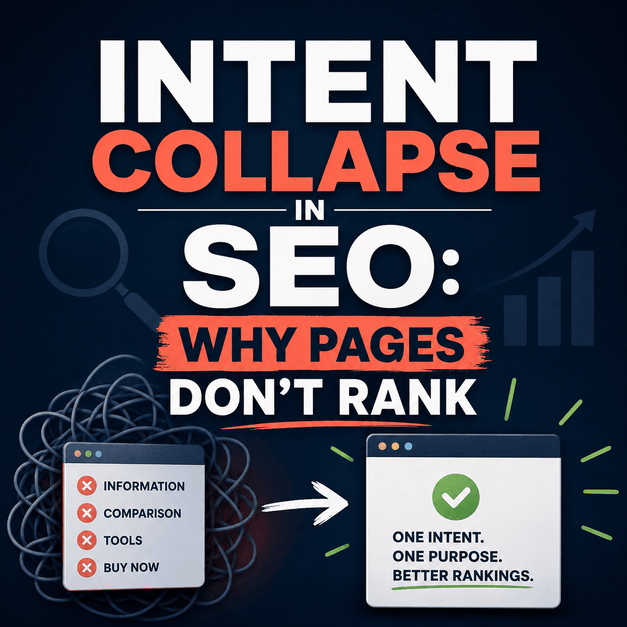
Most SEO content doesn’t fail because it’s poorly written or poorly optimized after publishing. It fails earlier in the process due to intent collapse, where a single page tries to satisfy multiple conflicting user goals at once.
When informational, comparative, and transactional intents are combined into one page, clarity breaks down. Search engines struggle to assign relevance, users don’t get a clear outcome, and performance weakens before optimization even matters.
As search systems become more intent-driven and AI models increasingly break queries into multiple sub-intents, intent clarity is becoming a critical factor in visibility and citation potential.
Introduction: Why SEO Problems Start Earlier Than You Think
When a page doesn’t rank, the usual explanations point to things like backlinks, keyword targeting, or on-page optimization. Those factors matter, but they’re often not the real reason a page fails.
A lot of SEO content never had a real chance to perform in the first place.
The issue starts earlier, during planning and structuring, when a page quietly takes on too many competing goals. It tries to inform, compare, persuade, and sell all at once. That’s where intent collapse happens.
And once it sets in, no amount of optimization can fully fix it.
This idea connects closely to some of the most common SEO execution issues, especially those covered in common SEO blogging mistakes that quietly hurt performance, where structural and strategic errors often show up long before publishing.
Intent collapse is what happens when those mistakes compound into a single structural failure.
What Intent Collapse in SEO Actually Means
Intent collapse in SEO happens when a single page tries to satisfy multiple conflicting user intents at the same time.
Instead of aligning to one clear purpose, the page blends several different search goals, such as:
- learning what something is
- comparing options
- evaluating tools or solutions
- making a purchase decision
On the surface, this looks comprehensive. In reality, it creates confusion for both users and search engines.
Each intent represents a different decision state. When those are merged into one page, none of them are served clearly enough to perform well.
Why Search Systems Struggle With Mixed Intent
Modern search systems aren’t just matching keywords anymore. They’re mapping intent clarity.
When a page mixes intents, it sends conflicting signals:
- Is this informational or transactional?
- Is this for beginners or advanced users?
- Is the goal explanation or decision-making?
Search engines are built to reduce uncertainty. Pages that blur intent boundaries increase uncertainty, which reduces ranking confidence.
This becomes even more important in AI-driven search environments where systems break queries into multiple sub-intents before assembling answers.
That behavior is explored in depth in how to optimize for query fan-out in AI search, where one query expands into multiple underlying intent pathways.
Query fan-out expands one search into multiple hidden questions. If your page already suffers from intent collapse, it becomes even harder for systems to match it to a specific sub-intent.
How Intent Collapse Shows Up in Real Content
Intent collapse usually isn’t obvious when you’re writing. It often looks like good SEO content on the surface.
Here are the most common patterns:
1. The “Ultimate Guide” Problem
One page tries to cover definition, strategy, tools, and buying decisions in a single article.
2. Mixed Funnel Stages
Awareness-level education is combined with conversion-focused content.
3. Multiple Audiences in One Page
Beginners, intermediates, and experts are all being targeted at once.
4. Keyword Expansion Overload
A page is built to rank for too many variations instead of serving one core intent.
5. Forced Comprehensiveness
More content gets added to increase perceived authority, but it ends up diluting clarity instead.
The result is a page that tries to do everything but doesn’t clearly succeed at anything.
Why Intent Collapse Leads to Poor Rankings
Search engines reward clarity.
When intent is fragmented:
- relevance signals weaken
- engagement becomes inconsistent
- user satisfaction drops
- ranking stability declines
Even if a page attracts impressions, it often fails to convert those impressions into meaningful engagement.
And even when visibility does occur, the outcome doesn’t always translate into traffic.
This is becoming even more visible with AI-driven search experiences, where users may see content without clicking it at all. That shift is discussed in why CTR is breaking under AI Overviews and what “view-through trust” means for SEO’s future.
In these environments, intent clarity isn’t just a ranking factor; it’s a visibility survival factor.
How to Detect Intent Collapse Before Publishing
You can usually catch intent collapse early if you shift how you evaluate content.
Instead of asking “Does this cover everything?” ask:
What’s the single decision this page helps someone make?
If you can’t clearly answer that, the page likely contains multiple competing intents.
A simple diagnostic framework:
- Learn → informational intent
- Compare → evaluation intent
- Decide → transactional intent
If a page tries to serve more than one of these at the same time, it needs to be split.
How to Fix Intent Collapse in Your Content Strategy
Fixing intent collapse isn’t about editing. It’s about restructuring.
1. Split content by intent, not topic
Instead of one “ultimate guide,” create separate intent-specific pages.
2. Build intent clusters
Organize content into connected pages like:
- What it is (learning intent)
- How it compares (evaluation intent)
- Best options (decision intent)
3. Strengthen internal linking
Use links to connect intent stages instead of merging them into one page.
4. Design for one outcome per page
Each page should answer one primary question clearly and completely.
This turns content from a collection of posts into a structured intent system.
Why This Matters More in AI Search
AI systems don’t treat pages as destinations. They treat them as source material.
They extract fragments, combine answers, and assemble responses dynamically.
That means:
- unclear intent reduces extractability
- mixed signals reduce citation likelihood
- fragmented pages are harder to reuse in AI-generated answers
In other words, intent collapse doesn’t just hurt rankings. It reduces the chance of your content being used at all in AI-generated experiences.
Clear intent increases the likelihood that a page becomes a reliable source component.
Conclusion: SEO Isn’t a Content Problem, It’s a Structure Problem
Most SEO underperformance isn’t caused by weak writing or missing keywords.
It’s caused by structural confusion introduced before publishing ever begins.
Intent collapse is one of the most common but least discussed reasons content fails. And as search systems become more intent-driven, the cost of ignoring it keeps increasing.
The future of SEO isn’t about producing more content.
It’s about producing clearer intent.
FAQ
What is intent collapse in SEO?
Intent collapse happens when a single page tries to serve multiple conflicting user intents, reducing clarity and performance in search results.
Why does intent collapse hurt rankings?
Search engines prioritize pages that clearly match a single intent. Mixed-intent pages create ambiguity, which reduces ranking confidence.
Is intent collapse the same as keyword cannibalization?
No. Keyword cannibalization happens across multiple pages. Intent collapse happens within a single page that tries to serve too many goals at once.
How does query fan-out relate to intent collapse?
Query fan-out breaks one search into multiple sub-intents. If your page is already unfocused, it becomes harder for search systems to match it to any of them.
Can fixing intent collapse improve AI search visibility?
Yes. Clear intent improves how easily systems can extract and reuse your content in AI-generated answers.

0 Comments Add a Comment?