



Query Fan-Out vs. Query Clustering: What's the Difference in SEO?
Quick Summary
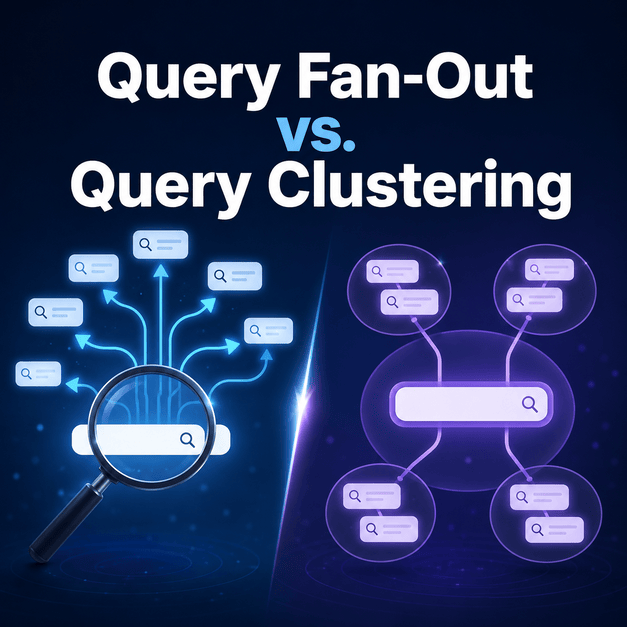
Query clustering and query fan-out both help search engines understand and retrieve information, but they serve different purposes. Query clustering groups related searches together based on shared intent, while query fan-out expands a search into multiple related queries to gather broader information. Understanding the difference is becoming increasingly important as SEO shifts from keyword targeting toward topic coverage, entity relationships, and AI-driven search experiences.
What Is Query Clustering?
Query clustering is the process of grouping similar search queries that share the same or closely related intent.
For example, searches such as:
- How does search query clustering work?
- What is query clustering in SEO?
- Keyword clustering explained
- Search query grouping for SEO
All revolve around the same underlying topic. Search engines recognize these relationships and often treat them as variations of a similar intent rather than entirely separate searches.
This helps search engines determine which content is most relevant for a topic without requiring a unique page for every keyword variation.
If you want a deeper look at the mechanics behind this process, my guide on how search query clustering works in SEO explains how search engines identify and organize related queries into meaningful groups.
Query clustering has become a foundational component of modern SEO because it encourages content creators to focus on topics rather than individual keywords. Instead of building 10 pages targeting slight keyword variations, you can create comprehensive content that satisfies the broader intent of an entire cluster.
What Is Query Fan-Out?
Query fan-out is different.
Rather than grouping similar searches together, fan-out expands a user's search into multiple related searches.
When someone asks a complex question, AI-powered search systems often break that query into several smaller searches to gather information from multiple angles before generating an answer.
For example, if a user searches:
"How does search query clustering affect AI search?"
An AI system may simultaneously explore related questions such as:
- What is query clustering?
- How do AI search engines retrieve information?
- What role do entities play in AI search?
- How does topical authority influence visibility?
- How do AI-generated answers cite sources?
Instead of relying on a single search, the system creates a network of searches.
This retrieval method has become increasingly important in AI-powered search experiences. In my article on why 29% of Google searches now lead to another search, I explain how fan-out behavior is changing the way information is gathered and presented to users.
The result is a broader, more comprehensive answer generated from multiple search paths rather than a single query.
Query Clustering vs. Query Fan-Out
Although the two concepts sound similar, they solve different problems.
| Query Clustering | Query Fan-Out |
|---|---|
| Groups related searches together | Expands searches into additional searches |
| Helps understand intent | Helps gather information |
| Supports ranking systems | Supports answer generation systems |
| Focuses on query relationships | Focuses on information retrieval |
| Common in traditional search | Common in AI-powered search |
One organizes information. The other retrieves information. Both are increasingly important for SEO.
How Google Uses Query Clustering
Google has used query clustering concepts for years to better understand user intent.
When multiple searches represent essentially the same need, Google can deliver similar results without requiring separate pages for every keyword variation.
This helps search engines:
- Understand search intent more accurately
- Reduce duplicate search results
- Identify topic relevance
- Reward comprehensive content
- Evaluate topical expertise
This is one reason why exact-match keyword strategies have gradually lost effectiveness. Search engines increasingly understand that different phrases can represent the same underlying question.
As Google's systems become more sophisticated, content that addresses a topic thoroughly often performs better than content narrowly optimized around a single keyword phrase.
How AI Search Engines Use Query Fan-Out
AI search introduces a different challenge.
Instead of ranking a list of links, AI systems often need to generate a direct answer.
To do that effectively, they frequently perform multiple retrieval actions behind the scenes.
A search about SEO strategy may trigger searches related to:
- Content optimization
- User intent
- Topical authority
- Entity relationships
- Search behavior trends
These additional searches allow the AI system to gather information from multiple perspectives before constructing a response.
This is partly why AI-generated answers often seem broader than traditional search results. The system is not evaluating a single query. It is evaluating an entire network of related searches.
My guide on how to optimize for query fan-out in AI search explores how content creators can increase visibility across these expanded retrieval pathways.
Why Query Fan-Out Changes SEO
Traditional SEO often focused on ranking for a specific keyword.
Fan-out changes that approach.
When AI systems expand searches into related topics, content may surface for questions that users never directly searched.
For example, a page about query clustering might appear in AI-generated answers about:
- Semantic SEO
- Search intent
- Topic clusters
- Topical authority
- AI retrieval systems
As a result, content depth becomes increasingly important.
Rather than creating isolated articles that answer one question, successful content often addresses related concepts that naturally connect to the primary topic.
The broader your topical coverage, the more opportunities AI systems have to retrieve your content during fan-out searches.
How to Optimize for Both Query Clustering and Query Fan-Out
The good news is that many SEO best practices support both systems.
Focus on:
Building Topic Clusters
Create supporting articles around your primary topics rather than relying on standalone content.
Covering Adjacent Questions
Answer related questions that naturally arise from your core topic.
Strengthening Internal Linking
Strong internal links help search engines understand how topics connect across your site.
Using Entity-Rich Language
Mention relevant concepts, tools, brands, technologies, and industry terminology where appropriate.
Expanding Topical Coverage
Broader coverage increases the likelihood that AI systems retrieve your content during fan-out searches.
Following Real User Journeys
As I discussed in From Keywords to Query Paths: How Users Actually Search in 2026, modern search behavior is increasingly nonlinear. Users move through sequences of questions rather than isolated searches. Content strategies should reflect those evolving search paths.
Query Clustering vs. Fan-Out: A Real Example
Imagine a user searches:
"How does search query clustering work?"
Traditional query clustering might group related searches such as:
- Query clustering SEO
- Keyword clustering
- Search query grouping
- Clustered keywords
These searches all share a similar intent.
A fan-out system, however, may expand into related searches such as:
- What is topical authority?
- How do AI search engines retrieve content?
- What are semantic entities?
- How does search intent affect rankings?
- How do AI Overviews gather information?
The clustering system identifies relationships between queries.
The fan-out system explores relationships between topics.
This distinction helps explain why content that covers broader contextual information often performs well in AI search environments.
The Future of SEO: Optimizing for Expansion, Not Just Keywords
The shift from keyword-first SEO to topic-first SEO has been underway for years. AI search is accelerating that trend.
Query clustering helps search engines understand what users mean. Query fan-out helps AI systems discover what information is needed to answer those questions comprehensively.
Together, they encourage a more holistic approach to content creation.
Instead of asking, "What keyword should I target?"
A better question may be:
"What network of related questions should this content help answer?"
The websites that succeed in 2026 are increasingly the ones that build topic ecosystems rather than individual keyword pages.
Conclusion
Query clustering and query fan-out represent two different but complementary ways search systems process information.
Query clustering groups similar searches together to better understand user intent. Query fan-out expands searches into additional retrieval paths to gather information from multiple perspectives.
For SEOs, the takeaway is clear. Ranking for a keyword is no longer enough. Modern visibility depends on how well your content fits into a larger network of topics, entities, and related questions.
The more comprehensively you cover a subject, the more opportunities search engines and AI systems have to surface your content.
As search continues evolving toward AI-generated answers and multi-step retrieval systems, understanding both query clustering and query fan-out will become an increasingly important competitive advantage.
Frequently Asked Questions
Is query fan-out replacing query clustering?
No. Query fan-out and query clustering serve different functions. Query clustering helps search engines understand intent, while query fan-out helps AI systems gather information. Both can operate together within modern search systems.
Why is query fan-out important for SEO?
Query fan-out increases the number of related searches AI systems may use when generating answers. Content that covers connected topics has more opportunities to appear during these retrieval processes.
Does Google use query fan-out?
Google has publicly discussed query fan-out retrieval techniques in AI-powered search experiences. Similar retrieval methods are also used by many modern AI search systems.
Should I create separate pages for every keyword cluster?
Usually not. If multiple keywords share the same intent, a single comprehensive page often performs better than several overlapping pages.
How can I optimize content for both clustering and fan-out?
Focus on topical depth, answer related questions, build supporting content around core topics, strengthen internal linking, and create content that reflects real user search journeys rather than isolated keywords.
Which matters more in 2026: query clustering or query fan-out?
Both matter. Query clustering remains important for traditional rankings, while query fan-out is becoming increasingly important for visibility within AI-generated search experiences. The strongest SEO strategies account for both.

0 Comments Add a Comment?