



What Are Entities in SEO? The Foundation of AI Search
Quick Summary
Entities are people, places, brands, products, concepts, and other identifiable things that search engines understand independently of keywords. They help Google connect information through the Knowledge Graph, understand relationships between topics, and generate AI-powered search results. As search shifts toward AI Overviews, AI Mode, and answer engines, entities have become one of the foundational building blocks of modern SEO.
Introduction
Google doesn't rank keywords. It ranks its understanding of what those keywords represent.
When someone searches for "Tesla," Google knows they're probably looking for the company, not the inventor Nikola Tesla. When someone searches for "Jaguar," Google uses context to determine whether they mean the animal or the car brand. That understanding comes from entities.
Entities have become a core part of how search engines interpret content, connect topics, build AI-generated answers, and organize information in the Knowledge Graph. As search continues shifting toward AI-driven experiences, understanding entities is becoming increasingly important for SEO.
Let's look at what entities are, how they influence modern search, and why they matter for everything from Google's Knowledge Graph to AI Overviews and query fan-out.
What Is an Entity in SEO?
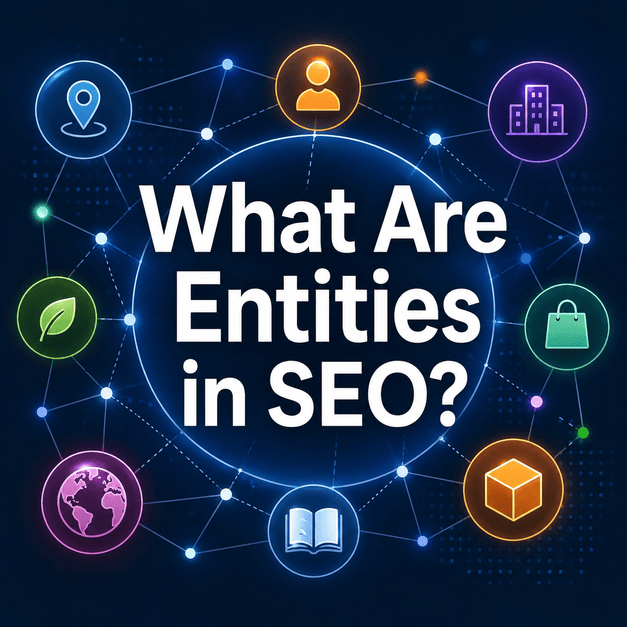
An entity is a uniquely identifiable person, place, organization, product, concept, event, or thing that search engines can recognize and understand.
Unlike keywords, entities have meaning beyond the words used to describe them.
For example, Google understands that "New York City," "NYC," and "The Big Apple" all refer to the same entity. Likewise, it knows that "Apple" could refer to a technology company or a fruit depending on the context surrounding the search.
Examples of entities include:
- People: Taylor Swift, Elon Musk, Marie Curie
- Companies: OpenAI, Nike, Tesla
- Places: San Diego, New York City, Paris
- Products: iPhone, ChatGPT, Tesla Model Y
- Concepts: Search Engine Optimization, Artificial Intelligence, Machine Learning
- Events: Super Bowl, World Cup, Black Friday
This ability to understand things rather than simply match words is one of the biggest reasons search has become more sophisticated over the past decade.
Why Entities Matter in AI Search
AI search depends on understanding relationships between concepts.
When someone asks ChatGPT, Google AI Mode, or an AI Overview a question, the system isn't simply looking for pages that contain matching keywords. It is trying to identify relevant entities and understand how they connect.
For example, a search about SEO entities may involve related entities such as:
- Knowledge Graph
- Semantic search
- Structured data
- AI Overviews
- Topical authority
- Query clustering
The AI system uses these relationships to build a comprehensive answer.
This is one reason why entity optimization and AI visibility often overlap. When content clearly explains concepts, relationships, and supporting facts, it becomes easier for AI systems to understand and cite.
The same principle is behind AI fact coverage optimization. AI systems need clear, verifiable information about entities and how they relate to one another. The better your content provides that context, the easier it becomes for answer engines to use.
How Google Uses Entities
Google stores information about entities and their relationships within the Knowledge Graph.
Think of it as a massive network of connected information.
For example:
- Tesla is connected to Elon Musk.
- Elon Musk is connected to SpaceX.
- SpaceX is connected to reusable rockets.
- Reusable rockets are connected to space exploration.
These connections help Google understand context when users search.
Instead of simply finding pages that contain certain words, Google can understand what those words represent and how they relate to other topics.
This is why Google's Knowledge Graph plays such an important role in modern SEO. If you're interested in learning more about how it works, my guide on optimizing for the Google Knowledge Graph explores the topic in greater detail.
Entities vs. Keywords
Keywords and entities work together, but they aren't the same thing.
| Keywords | Entities |
|---|---|
| Words or phrases users search for | Real-world things and concepts |
| Focus on text matching | Focus on meaning |
| Can be ambiguous | Are uniquely identifiable |
| Help indicate intent | Help establish context |
| Trigger searches | Help search engines understand searches |
Consider the keyword "mercury."
Without context, Google cannot know whether you're referring to:
- The planet Mercury
- The chemical element mercury
- Mercury Marine
- The Roman god Mercury
Entities help remove that ambiguity by identifying the specific thing being discussed.
This allows search engines to deliver more accurate results and generate more precise AI answers.
How Entities Connect to Query Clustering
One of the biggest shifts in modern SEO is Google's ability to recognize when multiple keywords represent the same topic.
For example, these searches may all belong to the same cluster:
- What are entities in SEO?
- Entity SEO explained
- What is entity optimization?
- How do entities affect rankings?
- Entity-based SEO
The wording differs, but the underlying topic remains largely the same.
Rather than treating each keyword as a completely separate search, Google often groups them together because they revolve around the same entities and concepts.
This is the foundation of search query clustering. As I explain in my guide on how search query clustering works in SEO, understanding topic relationships often matters more than targeting individual keyword variations.
How Entities Influence Query Fan-Out
Entities also play an important role in query fan-out.
When AI systems receive a question, they often expand the search into multiple related questions behind the scenes.
For example, a question about entities in SEO might trigger additional research into:
- Knowledge Graphs
- Semantic search
- Structured data
- AI Overviews
- Natural language processing
- Entity relationships
Each additional query helps the system gather more context before generating an answer.
This process is one reason AI-generated responses often pull information from multiple sources and multiple related topics.
If you'd like a deeper look at how this works, my article on query fan-out optimization for AI search explains why AI systems increasingly search across networks of related entities rather than relying on a single query.
How to Optimize Content for Entities
Entity optimization isn't about stuffing more keywords into a page. It's about helping search engines understand exactly what your content is about. Some practical ways to improve entity optimization include:
Identify Your Primary Entity
Every page should have a clear central topic, person, brand, product, or concept.
Include Related Entities
Cover supporting concepts that naturally connect to the main topic. For example, a page about entity SEO may also discuss semantic search, the Knowledge Graph, structured data, and AI search.
Build Topic Depth
Answer related questions and cover adjacent concepts rather than focusing on a single keyword phrase.
Use Clear Definitions
Explicitly explain important concepts and terminology. This makes it easier for both users and search engines to understand the topic.
Strengthen Internal Links
Internal links help reinforce relationships between topics across your website.
Use Structured Data
Schema markup provides additional clues about entities and how they relate to one another.
The Future of SEO Is Entity-Based
Keywords aren't disappearing.
People will continue using words to search.
What's changing is how search engines interpret those words.
Google increasingly relies on entities and relationships to understand content, organize information, and generate AI-powered answers. AI search systems take this even further by building responses around connected concepts rather than exact keyword matches.
As AI search continues to evolve, the websites that perform best will be the ones that help search engines clearly understand topics, relationships, and facts.
In other words, successful SEO is becoming less about matching keywords and more about communicating meaning.
Conclusion
Entities are the foundation of how modern search engines understand the web.
They help Google identify people, places, brands, products, and concepts while connecting them through relationships in the Knowledge Graph. They also play a critical role in AI Overviews, AI Mode, query clustering, query fan-out, and answer engine optimization.
Keywords still matter because they help users express what they're looking for. But entities help search engines understand what those words actually mean.
As search becomes increasingly AI-driven, understanding entities is becoming one of the most important skills in modern SEO.
FAQ
What is an entity in SEO?
An entity is a uniquely identifiable person, place, company, product, concept, event, or thing that search engines can recognize and understand independently of keywords.
Why are entities important for SEO?
Entities help search engines understand meaning, context, and relationships between topics, leading to more accurate rankings and AI-generated answers.
Are entities more important than keywords?
Keywords still matter, but entities help search engines interpret those keywords. Modern SEO requires both.
How do entities relate to Google's Knowledge Graph?
The Knowledge Graph is Google's database of entities and their relationships. It helps Google understand how topics connect across the web.
What is entity optimization?
Entity optimization involves creating content that clearly defines topics, covers related concepts, and helps search engines understand relationships between entities.
Do entities affect AI Overviews?
Yes. AI Overviews rely heavily on entities and relationships to understand topics and generate answers. Content with strong entity coverage is often easier for AI systems to interpret and cite.

0 Comments Add a Comment?