



Why 29% of Google Searches Now Lead to Another Search (Query Fan-Out in SEO 2026)
Quick Summary
Why are 29% of Google searches now leading to another search instead of a click?
Because AI Overviews in Google Search are changing how users behave. Instead of ending a journey after one query, users increasingly refine, expand, and repeat searches through query fan-out behavior and conversational search.
This shift has grown from 21.4% in 2024 to 29% in 2026, according to SparkToro, signaling a major change in search behavior, SEO strategy, and Google search psychology.
For SEO, this means optimization is no longer about single keywords—it’s about query paths, topic clusters, and search journeys.
The Statistic Everyone Focused on Wasn’t the Most Important One
When SparkToro published its latest research on Google Search behavior and zero-click searches in June 2026, most attention went to one headline: a large share of searches no longer result in website clicks.
But a more important shift is happening underneath that surface.
According to SparkToro, 29% of Google searches now lead directly to another search instead of a click.
This reflects a structural change in how people use Google Search, AI Overviews, mobile search experiences, and conversational search interfaces.
Instead of completing a single search journey, users now enter multi-step search loops.
This is the foundation of query fan-out in SEO.
Query Fan-Out Is One of the Biggest SEO Shifts of 2026
Query fan-out refers to users expanding a single search into multiple related searches.
For example, a user searching for “best hiking shoes” might not stop at one result. Instead, their journey expands into connected refinements such as:
- “best hiking shoes for flat feet”
- “Hoka vs Brooks hiking shoes”
- “best waterproof hiking shoes 2026”
- “lightweight trail shoes for beginners”
This creates a branching search experience rather than a linear path from query to click.
According to SparkToro’s research on search behavior trends, this pattern has accelerated significantly, with the share of searches leading to another search increasing from 21.4% in 2024 to 29% in 2026.
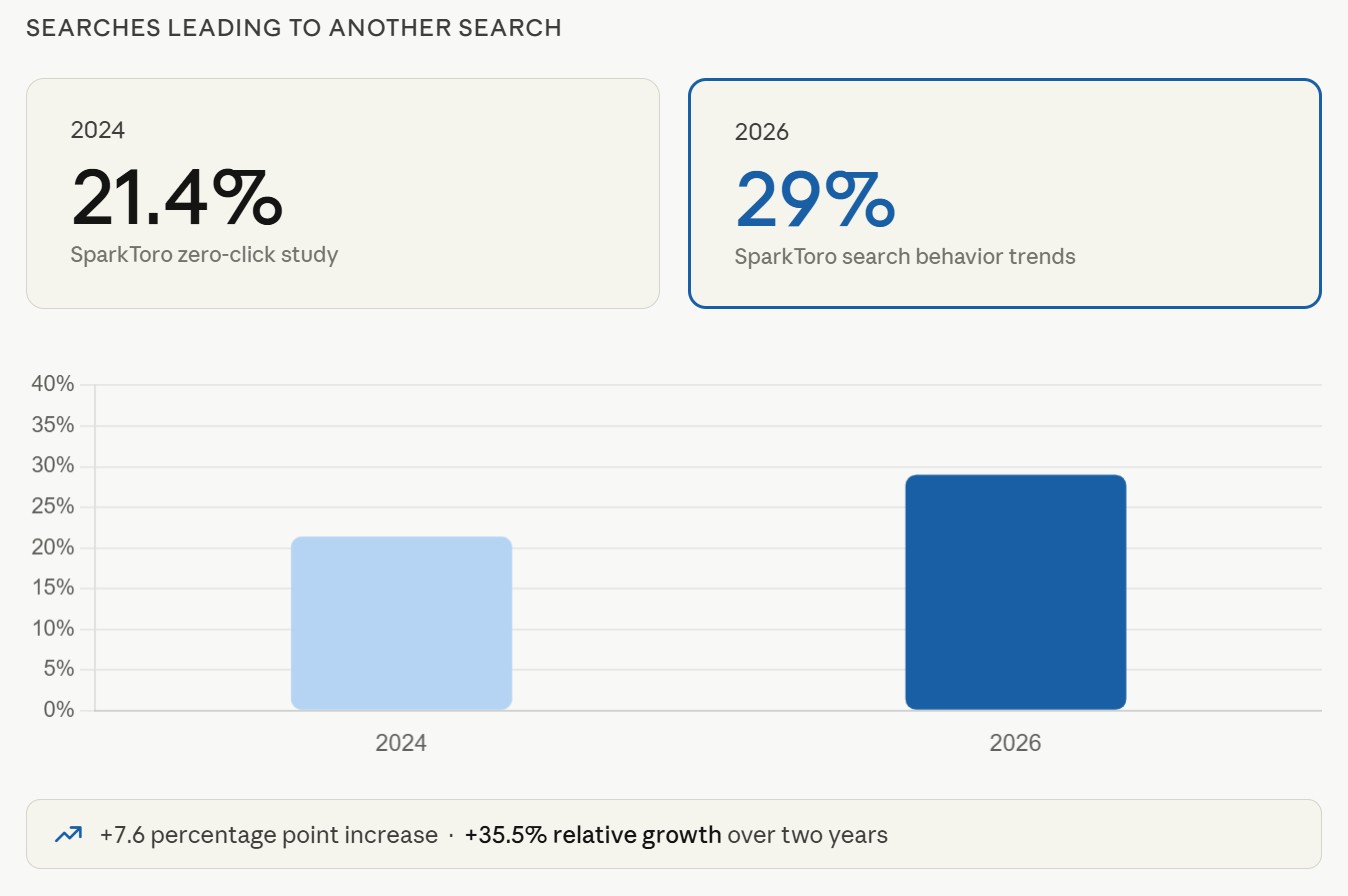
That jump highlights just how quickly recursive search behavior is becoming the norm.
Search Behavior Is Becoming Iterative (Not Linear)
Traditional SEO assumed a simple funnel:
Search → Click → Convert
But modern Google Search behavior, especially with AI Overviews, looks more like a cycle of refinement and expansion.
Users search, then refine their query, compare options, search again, and gradually expand intent over time.
This shift is closely tied to AI Overviews in Google Search, Search Generative Experience (SGE) concepts, conversational search interfaces, and mobile-first discovery behavior.
In this model, Google functions less like a list of links and more like an intent exploration system.
Why Query Fan-Out Is Increasing So Quickly
Several forces are driving this shift in behavior.
AI Overviews increase curiosity instead of closure
AI Overviews often introduce comparisons, adjacent topics, definitions, and alternative queries within the answer itself. Instead of resolving intent, they frequently expand it.
Search psychology is changing
Users are no longer satisfied with a single answer. Instead, they are looking for:
- context
- validation
- comparison
- depth
This naturally leads to repeated searching as understanding evolves.
Conversational search behavior
Search increasingly resembles:
- ChatGPT-style exploration
- Reddit rabbit holes
- TikTok discovery loops
This creates continuous intent expansion instead of single-query resolution.
Google Is Reinforcing Search Expansion
This behavioral shift also aligns with Google’s incentives.
More searches lead to:
- more ad impressions through Google Ads
- more engagement signals
- more behavioral data
- longer session duration inside Google’s ecosystem
Rather than one-and-done queries, Google increasingly supports multi-query sessions that extend user engagement across longer search journeys.
SEO Strategy Is Shifting From Keywords to Query Paths
This is where the strategic impact becomes clear. Instead of optimizing for isolated keywords, SEO is moving toward query paths and connected search journeys.
You can see this shift clearly in how users now move from keywords to structured search journeys in my article From Keywords to Query Paths.
Search is no longer a single query system. It is a connected network of evolving intent that unfolds over time.
Search Query Clustering Becomes Critical
As query fan-out increases, search engines rely more heavily on semantic clustering to understand how topics connect.
Instead of evaluating isolated keywords, Google now looks at:
- topic relationships
- semantic similarity
- intent overlap
- content depth
This is how Google determines authority in an AI-driven search environment.
AI Search Rewards Anticipating the Next Query
Winning content in AI search does not just answer the immediate query. It also anticipates what the user is likely to search next.
That is why query fan-out optimization has become so important in modern SEO strategy.
Strong content does not stop at answering the question. It expands naturally into comparisons, related topics, and follow-up questions.
Google’s Search Psychology Is Changing User Behavior
Users are also shifting how they mentally frame search itself.
Instead of treating Google as a destination for answers, they increasingly treat it as:
- an exploration tool
- a conversational interface
- a refinement engine
This change in mindset is a major driver behind rising query fan-out behavior.
The Future of Search Is Not One Query—It’s a Chain
Search is becoming continuous and recursive.
We are moving toward:
- query chains instead of single queries
- intent pathways instead of funnels
- topic ecosystems instead of standalone pages
That is why 29% of searches now lead to another search. Search is no longer a destination—it is an ongoing process of exploration and refinement.
Conclusion
The rise of AI Overviews in Google Search has not just reduced clicks. It has fundamentally reshaped how people search.
Users are now:
- searching again
- refining intent
- expanding topics
- moving through query fan-out loops
This behavior has increased from 21.4% in 2024 to 29% in 2026 according to SparkToro, showing just how quickly recursive search behavior is accelerating.
For SEO professionals, this means traditional keyword optimization is no longer sufficient. The future of SEO depends on understanding query paths, semantic relationships, and full search journeys.
Search is no longer about ranking for a query. It's about staying relevant across the entire journey of how people think and search.
FAQ
What is query fan-out in SEO?
Query fan-out is when users expand a single search into multiple related searches instead of clicking a result immediately, reflecting a more iterative and exploratory search behavior.
How much has query fan-out increased since 2024?
According to SparkToro’s research on Google search behavior, the share of searches leading to another search has increased from about 21.4% in 2024 to 29% in 2026.
Why are users searching more instead of clicking results?
AI Overviews and conversational search experiences encourage users to refine, compare, and expand their queries instead of stopping after one answer.
Is query fan-out the same as zero-click search?
No. Zero-click search refers to when users do not click a result, while query fan-out refers to when users issue additional searches after their initial query.
How should SEO adapt to query fan-out?
SEO should shift toward query paths, topic clusters, and semantic coverage so content supports multiple stages of a user’s evolving search journey.

0 Comments Add a Comment?